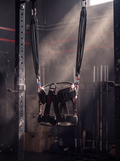
FIRST FLIP BACKFLIP TRAINER
YOUR PERSONAL BACKFLIP SPOTTER
A portable bungee harness that mounts to any pull-up bar or strong branch.
- Repeat the motion to build muscle memory
- Eliminates fear of jumping backwards
- Build real confidence, fast
- Beginner-friendly & safe
- Train indoors or out
🔥 Free training guide included for the next 50 orders!
Yes. Heavy-duty braided bungee cords and a full-body harness. Each of the two 12 mm shock cords was load-tested in our own lab to a 2,200 N (~224 kg) breaking load, and the end loops held to 1,400 N (~143 kg) before any slip. The bungees decelerate your rotation and soften landings. We always recommend mats or grass, checking your setup before every session, and having someone nearby when you train.
Any sturdy pull-up bar (wall-mounted or freestanding) or a strong tree branch. The mounting strap loops securely — no drilling or permanent installation.
Rider weight limit: 100 kg (220 lb). For reference, each of the two 12 mm cords was load-tested in our own lab to a 2,200 N (~224 kg) breaking load, with the end loops holding to 1,400 N (~143 kg) before any slip.
Not at all. Designed for complete beginners. If you can jump, you can use it. The cords' resistance climbs steadily the further they stretch (see the lab data below), so you start with full support and gradually build toward unassisted flips.
Most users progress to unassisted backflips within 7–14 days of consistent practice. The device builds confidence and muscle memory so the transition feels natural.
You need enough ceiling height for rotation (9+ feet) and a sturdy mounted bar. Standard 8-foot ceilings are too low. A backyard, garage, or park pull-up station works great.
LOOK AT HOW OTHERS ARE LANDING IT
Real reviews from real people
Lab-tested cord
WE PULLED IT UNTIL IT BROKE.
HERE'S THE DATA.
We load-tested the 12 mm braided shock cord in every First Flip on a tensile rig in our own lab. Two cords per trainer, one each side — these are the figures recorded per cord.
Load ladder — per cord
Each bar is one cord. Orange is the reference load for normal use; every bar above it is recorded headroom before the end loop slipped, the termination failed, or the cord body broke.
Progressive stretch
Load recorded at each elongation step. Resistance climbs steadily the further the cord stretches — the deeper you drop, the harder it pulls back.
- One cord
- Two cords — as installed
Figures from our own lab testing of the 12 mm shock cord on a tensile rig — not a load limit for the trainer, which runs two cords, one each side. Always train on mats, check your setup before every session, and have someone nearby.
Built for Safety
TRAIN HARD.
LAND SAFE.
We know you're trusting this device with your neck — literally. Every component is over-engineered because the fear of injury shouldn't stop you from learning.
- Heavy-duty 12 mm braided shock cords, load-tested to 2,200 N (~224 kg) per cord — two cords per trainer
- Reinforced harness with padded waist belt and leg loops
- Carabiner attachment at every connection point
- Recommended use on mats or grass for added protection
- Do a few jumps first to confirm tension in the elastic cords
- Sit back and test the lowest point before you jump, so you know what to expect
- We still recommend having someone nearby when you train